



When Seventh Heaven Collapses into Daily Routine
From the new series: Decoding the Matrix of Intimate Relationships – Part 1
From the myth of the wedding as the pinnacle of happiness, through unconscious compensatory mechanisms, to quiet emotional withdrawal – The dynamic between hero pressure and feminine expectations.
An important introductory note:
The behavioral patterns of women and men outlined in this article by no means speak for every individual woman or man. From my perspective, these reflect archetypal role programs deeply anchored in the collective subconscious that we unconsciously project into our relationships and live under the shadow of. My intention is neither to play genders against each other nor to indulge in clichés. Rather, today’s invitation is to decode the hidden mechanisms that cause us to act almost on remote control – enabling us to genuinely understand the subconscious dynamics operating within intimate partnerships (including same-sex relationships).
The Unwritten Chapter After the Happy End – or: The Liberated Princess, What Now?
A couple sits together in familiar intimacy in front of the screen, watching a film they have long looked forward to. Before their eyes unfolds a dramatic narrative marked by distressing crises, heart-wrenching turning points – and, naturally, a heartwarming happy end. This narrative structure has accompanied us since earliest childhood – from Little Red Riding Hood and Cinderella to enchanted princesses who had to be rescued from a dragon by a valiant hero or awakened from a hundred-year slumber with a tender kiss.
At first glance, one might assume fairy tales and romance are exclusively feminine preoccupations. Far from it!
The fundamental difference creating constraint and conflict in human relationships lies, among other factors, in gender-specific socio-emotional programming:
- For young girls, classical fairy tales almost universally culminated in an opulent dream wedding paired with the vague promise: “… and they lived happily ever after.” With this, the primary life milestone appeared achieved. Everything scheduled to follow remained veiled in mist or an absolute vacuum – or ultimately placed them under an implicit obligation of perpetual bliss.
- Boys, however, carried an entirely different narrative weight: the duty of heroic intervention! Liberating the “princess” marked the definitive pinnacle of their exertion.
These two patterns intrinsically condition one another:
The man who embodies the hero archetype instinctively seeks a partner (occupying the victim role) who finds herself in some form of physical, psychological, mental, or energetic captivity. Correspondingly, some women are subconscious conditioned to long for rescue by a chosen savior; they unconsciously navigate into distress, maintain crises, or even feign vulnerability so they can be recognized by the right suitor as the true princess whose foot fits the glass slipper.
Yet the moment the rescue is completed and joint fulfillment is supposed to begin, the systemic equilibrium shifts …
The Princess Awakens, the Prince Falls Asleep
Many of our beloved fairy tales suggest that marriage serves as heroic proof of boundless devotion that permanently delivers a woman from distress – thereby bringing the man’s trials and battles with dragons to a triumphant close. In real life, the dynamic is entirely reversed: The actual confrontation with inner dragons – provoked by the collision of two completely different worlds, if not two distinct galaxies – is only just getting underway.
In truth, rescuing the princess (even in classic myth) serves merely as a young man’s initial rite of passage. It is a preliminary test of whether he will possess the inner fortitude to confront the multi-headed monsters of everyday life. In tangible reality, these monsters correspond to the countless internal voices that tempt us away from our foundational path of love, trust, and autonomy toward peripheral distractions.
The Matrix does not sleep on the wedding day! Expectations rooted in inverted logic do not lift the bridal veil; instead, a haze of synthetic, commodified promises of happiness descends upon the couple’s consciousness. They become blind to the unresolved shadows they originally – if subconsciously – committed to encounter and integrate together as part of their shared personal evolution. It is as though the golden band were accompanied by a sedative whispering to the man that his chivalric service is concluded, and that blessing her with his mere (non-)presence is now entirely sufficient.
The 4 Phases of Alienation
Phase 1: The Wedding Peak and the Energetic Vacuum
Here emerges the foundational misattunement within the relationship: While the man views his task as complete upon conquest, the woman suddenly faces the exhausting task of sustaining lifelong happiness and love exactly as the fairy tales promised.
Do you recognize how the first “innocent” relational impasse takes root right here?
The man settles comfortably onto the sofa, convinced his heroic assignment is finished. In doing so, he unconsciously drops the woman into an emotional void. No fairy tale instructed her on how to manufacture sustainable joy in practice – especially beside a sleeping prince. She had placed her faith in the chivalrous knight on the white horse, anticipating that every subsequent step would be attentively strewn with rose petals.
Where did that knight suddenly vanish?

As the man relinquishes the pursuit in married life, he loses the dynamic vitality through which she first came to know him. He enters his desired phase of passive rest (after all, the dragon is slain and the princess is secure!), which gradually breeds disappointment and frustration in his partner. The princess has been awakened, yet the prince has fallen asleep. And this is supposed to be normal?!
During this phase, physical intimacy often becomes the sole arena where the man temporarily surfaces from his withdrawal – frequently experienced by the woman as lethargy – allowing glimpses of the former hero to reappear.
If the bedroom remains the only communicative bridge, the intimate connection meant to nourish the bond degenerates into mechanical routine or a subtle currency of control. Both parties attempt to extract what was once vowed: She seeks emotional validation and reassurance that she remains desirable and cherished; he seeks confirmation of his potency and attractiveness – securing his entitlement to undisturbed tranquility. The princess is safe, free to occupy herself with whatever she pleases!
As long as youthful naivety idealizes marriage as the absolute peak of human experience, the subconscious registers the logical corollary: everything following must inevitably decline. High divorce rates in modern culture frequently reflect a desperate attempt to escape this programmed regression. Through separation, individuals seek to awaken themselves from this stagnation, hoping to step back into autonomous vitality as singles and pursue a fresh promise of perpetual bliss – away from a complaining spouse.
Phase 2: The Child as a Source of Purpose
When the anticipated post-marital fulfillment fails to materialize, a woman often looks to her social sphere and maternal lineage. How did preceding generations navigate this emptiness?
The ancestral template appears straightforward: Holding a precious baby in her arms.
At this juncture, an evolutionary and psycho-energetic mechanism activates: To stabilize the partnership and restore vitality to existence, new life is brought forth.
Biologically, this inherited behavioral blueprint ensures the perpetuation of the species. Systemically and psychosomatically, however, the infant frequently serves as an interpersonal adhesive or an emotional life raft preventing total psychological collapse – an immense developmental burden for a newborn to carry.
In favorable circumstances, the mother flourishes in her nurturing role and resolves her disappointment regarding the demystified hero. In less integrated dynamics, she clings to maternity as an emotional surrogate to avoid facing underlying marital disillusionment. Alternatively, she remains suspended in the fairy-tale construct, casting the mobilized father into the role of heroic provider and projecting all lingering rescue fantasies onto him.
Phase 3: The Synthetic Dopamine Loop of Consumerism
Consumer society decoded these systemic deficits within narrative conditioning long ago and exploits them strategically. It regularly markets synthetic, perpetual “substitute honeymoons” detached from marital vows or relationship status:
- For the man, it reactivates competitive and heroic impulses: Unconsciously driven, he channels his vitality into overtime, career advancement, status symbols, sports cars, and technical innovations to feel capable, effective, and validated by material trophies.
- For the woman, market messaging suggests that missing fulfillment can be purchased through updated lifestyle trends, chronic self-optimization, compensatory retail therapy, and esoteric wellness seminars promising eternal magnetism, tranquility, and nirvana.
Both partners remain tethered to consumer loops driven by unresolved childhood blueprints – their attention perpetually fixed on an idealized future dangled like a proverbial carrot, effortlessly accelerating macro-economic growth.
Phase 4: The Vicarious Neural Life on Screen
Let us return to the living room scenario. A romantic comedy plays across the monitor – content typically designed to engage emotional resonance.
As the narrative on screen steers toward its resolution and dramatic kiss, two fundamentally divergent experiences unfold on the sofa:
The woman experiences an internal fragmentation. One part of her follows the storyline; a second feels the acute ache for genuine, authentic presence with her partner; a third hyper-vigilantly tracks his micro-expressions, trying to decode his reception of the film. She hopes for a breakthrough moment where the cinematic narrative reminds him of the depth and intentionality that originally bound them together.
The man, conversely, is absorbed in the narrative stream. He lives vicariously through the fiction, identifying with the protagonist, chasing challenges, laughing, and processing emotions as though he were part of the drama. He remains entirely unaware that his emotional vitality – the very engagement his partner craves beside him – has been outsourced to a scripted, virtual universe.
When the credits roll, he returns to physical reality emotionally recharged and contented, often genuinely perplexed by the chilled, tense atmosphere in the room. From his perspective, they just shared a pleasant evening. The woman, reading his state, masks her sharp disappointment that he did not once reach out to hold her. She remains quietly solitary, processing the painful realization that her partner can express emotional vitality anywhere – except in direct attunement with her.
Her prince, her king! Yet emotionally unavailable.
Unaware of the inner terrain of his companion, it never occurs to him to translate the engagement modeled on screen into their shared present moment. The heart of the former princess weeps in isolation. If she is fortunate, she might temporarily draw sustenance from his relaxed, buoyant mood … until everyday demands reclaim his focus.
A Brief Anecdote: Venice and the Bedside Lamp
To bring levity to this inquiry, consider a personal, nearly stereotypical experience:
As a young, ambitious, and self-directed entrepreneur (back when I was hardly aware that this already constituted self-emancipation!), I crossed paths with an affluent, charismatic man. An established business owner who drove – believe it or not – a red convertible sports car! It felt straight out of Pretty Woman, with the minor distinction that I was already running my own successful commercial enterprise.
Upon our initial meeting, he was instantly infatuated, while I categorized him as an accomplished playboy and bon vivant. I was around thirty at the time and harbored few romantic illusions about men. I agreed to a casual courtship – free of romantic pretense and simply curious about adult companionship, as was common among peers.
Several weeks elapsed before greater intimacy developed. The posturing dissolved. In its place, he began courting me with classic elegance: inviting me to exquisite venues, arranging five-star breakfasts, and driving me home with the top down – never overstepping boundaries or demanding more. He was worldly and witty, yet beneath the surface, visibly drained by commercial demands. Nonetheless, he remained determined to impress me. Unexpectedly, I experienced what it felt like to be treated like royalty, though I had never sought such validation.
He was operating from an internal script dictating what women universally desire. True to his mental blueprint, he orchestrated our first shared getaway with every requisite luxury: in Venice!
Presumably, he expected me to be overwhelmed with awe. Yet what was so remarkable about Venice? I had visited multiple times on my own and viewed it with pragmatic familiarity. When his romantic gesture failed to disarm me, he simply laughed, shook his head, and inexplicably seemed even more drawn to me.
Eventually, we traveled to Venice separately. He attended business appointments along the way, while I spent several restful days along the Croatian Adriatic coast. Anticipation built steadily. Venice welcomed us characteristically: with an entirely congested parking garage. Prior to checking into our luxury hotel, he arranged an exceptional candlelit dinner at an authentic ristorante.
Once in the suite, he reclined across the bed, removed his designer shirt with studied elegance, and draped it over the bedside lamp to soften the lighting and cultivate an intimate ambiance. Amused by the theatrical staging, I stepped into the bathroom to freshen up.
Imagine my astonishment when I emerged: He was sound asleep, completely dead to the world!
More than that: A pungent odor of burning fabric was filling the room. The incandescent bulb had burned a sizable hole straight through his expensive shirt! Yet not even the smoldering fire could pull him from his deep, restorative sleep. The next morning, he was more perplexed by his sudden exhaustion than anyone else. So much for the meticulously curated night of romance.
Years later, when I shared this story with my husband, he remarked with a smile:
“Take it as a genuine compliment. Only a man who feels completely safe and accepted in your presence can let go so thoroughly that all performance patterns and conditioned roles drop away, allowing pure physiological regeneration to take over – because he no longer has to prove anything.”
I hardly need to add that my husband falls asleep beside me just as easily and comfortably.
The Bridge Between Two Universes
Returning from Venice to everyday relationships:
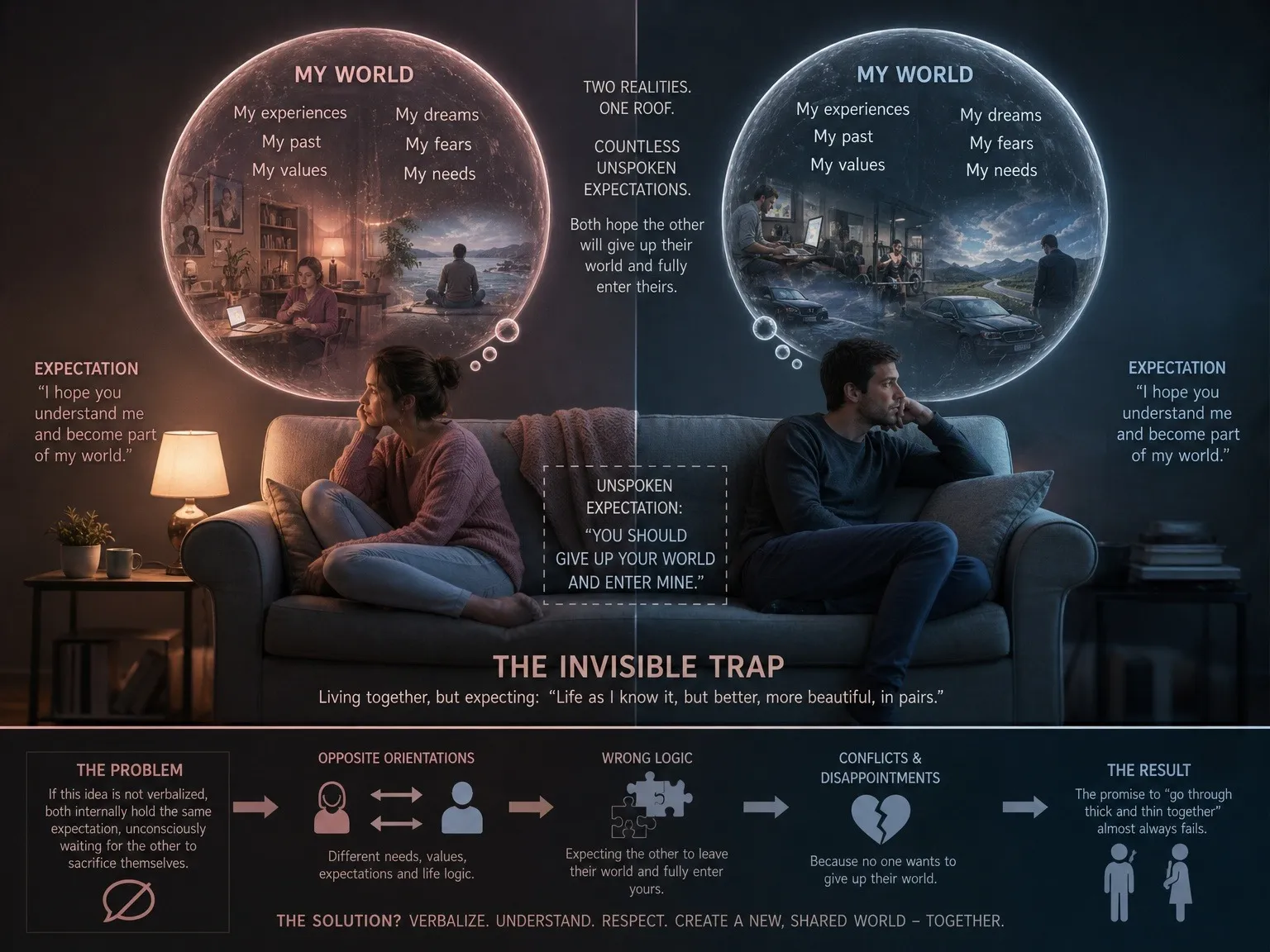
Couples frequently share the same living space for decades while remaining isolated within their respective perceptual bubbles. The pledge to stand together through thick and thin routinely falters because both partners navigate unacknowledged, divergent expectations. Or, operating from an inverted logic, they expect the other to abandon their native reality and relocate entirely – physically, mentally, and emotionally – into their partner’s world.
For some dynamics, an asymmetrical compromise functions passably. One person defers, or seeks sanctuary within the other’s reality. The breakdown occurs when these expectations remain unspoken and both harbor the silent demand that the other surrender their autonomous landscape. Both await fulfillment, demanding that their partner assimilate into their unyielding reality – as though proving true love required self-erasure to become a supporting actor in someone else’s narrative.
Both operate under an unconscious entitlement:
Life exactly as I know it – only upgraded, enhanced, and made effortless through a partner!
At this juncture, we must remember: For genuine encounter to occur at eye level, we must stop holding our partners accountable for fulfilling unconscious narrative programs that hyper-analyze every breath, glance, and gesture.
If we desire an equitable, developmental partnership where hands are extended across inevitable challenges, we must examine our emotional foundations with complete self-awareness and sovereign agency – showing up as an integrated whole rather than an incomplete half seeking completion. The objective is to build a conscious bridge between the distinct worlds each person brings to the union; honoring one’s own autonomy while deeply respecting the partner’s sovereignty as an independent being with their own internal landscape, core themes, and developmental trajectory.
In the next episode, we explore the deeper psychosomatic roots of this subconscious impasse: Why the accumulated anger in women is not accidental, why men stripped of projected performance expectations initially undergo a restorative crisis of meaning, and how we awaken ourselves to break the cycle of systemic disillusionment once and for all. Next episode here ->
Therapy Essence: Demystifying the Fairy Tale, Allowing Genuine Closeness
-
Unmasking the Unconscious Role-Playing: Rigorous self-observation regarding whether a helpless princess awaiting rescue still lingers within, or whether the partner is unconsciously held to the exhausting performance of an eternal dragon-slayer. Whenever union is predicated on heroic deliverance, proving devotion through exceptional feats, or delivering the heavens on demand, the partnership stagnates on a single evolutionary plateau—blocking organic progression and dissolving authentic equality at eye level.
-
Embracing the Post-Peak Vacuum: The emotional flatline following the initial honeymoon phase does not indicate declining love; it marks the natural expiration of an artificially maintained heroic protocol. Allow your partner to remove the heavy armor and transition into restorative stillness, rather than prematurely interpreting this natural withdrawal as a withdrawal of affection or a personal wound.
-
Seeing Through Compensatory Arenas: Cultivate acute vigilance regarding where internal emotional voids are being outsourced and compensated—whether through the idealization of parenthood, restless consumerism, career-driven trophy hunting, or transferring active emotional vitality into fictional storylines on screens. These diversions merely fuel the synthetic dopamine loop, bypassing the deeper heart and soul.
-
Respecting Two Universes—and the Emergence of the Third Path: Acknowledging and consciously releasing the unspoken demand that the other surrender their native reality, personal themes, developmental trajectories, and autonomous soul-objectives merely to assimilate into the perceptual bubble of their partner. A sustainable, resilient bond does not emerge from leveling differences; it is forged by intentionally constructing a bridge between two independent, sovereign worlds—where two distinct trajectories meet and give rise to a co-created, third path.
-
Transparent Communication Over Covert Expectations: Unarticulated assumptions systematically contaminate the interpersonal field. Genuine intimacy originates at the exact threshold where personal longings, vulnerabilities, and firm boundaries are articulated with clarity, rather than outsourcing relational safety to telepathic assumptions or demanding flawless deductive logic from a partner.
Core Question for You
© Kristina Hazler 08/2026 (All images and video media within the text are AI-generated)
PS: The new series “Decoding the Matrix of Intimate Relationships” expands upon my foundational essay „Transformation der verschmähten Frauenliebe kann die Welt retten“ (Transformation of Spurned Feminine Love Can Save the World).
Note: This text was translated from German “4 Phasen der Entfremdung in intimen Beziehungen“ to English using Deepl and AI
This post is also available at: