


True language is creation, not mere data transmission
True language has always been a rhythmic, creative process—a danced thought that touches the mind and soul like a precisely tuned tuning fork. However, in a world of screens, clicks, and statistics, the organic word is gradually coming under pressure.
Today’s post explores how our obsession with optimization and pursuit of dopamine have curtailed language and why the pressure to constantly create “content” is turning authors into exhausted number crunchers. What paradoxical opportunity lies in our encounter with artificial intelligence, which suddenly forces us to think more deeply and reinvent our humanity?
I was fortunate enough to write my first three books far removed from any rules, sales objectives, or social media marketing strategies—writing them simply for the sake of writing itself and the pure creative process. My motto was: If the book speaks to even a single person and helps them, then my work had served its purpose and was successful.
Ever since my childhood, it had been my desire to write, and that’s exactly what happened. While writing, I realized very early on that I was immersing myself in a completely different kind of vitality than in ordinary everyday life—a state I might otherwise have known only from carefree dancing. When writing from a place of inspiration, the words rise up from within me as if they were dancing with me: in waves, in the rhythm of the respective theme, and with a corresponding energetic radiance. This dance of words used to be evident in my long, sweeping sentences, which only brought the thread of thought to a close at the end of the sentence when the rhythm and energy placed the decisive emphasis at the end of the line or at a comma.

Just as everything in the cosmos is sound, color, information, and energy, harmonizing with one another, so too can the right words, placed in the right spot, be filled with content that resonates accordingly. In human consciousness, they then unfold with the same rhythmic elegance and set the unique melody of the individual in motion. Just like a precisely tuned tuning fork, the truthful word is capable of touching, speaking to, and enriching both the human mind and the soul.
In a similar way, the great poets and thinkers wrote over the course of centuries and millennia: they sang of the stars, the moon’s orbits, the grandeur of the Earth, and the mystery of human love; or, with dark drum rolls and deep tones, they lamented the spiritual abysses and base instincts of existence.
And then, almost overnight, search engines took the stage. Suddenly, we found ourselves in a situation where we had to explain to machines—using appropriate phrasing and artificial codes—what the respective texts were actually about. Texts no longer found their readers in an atmospheric bookstore or a quiet corner of the library, but on the cold, bluish-glowing screens in living rooms or sterile offices.
The artful use of language seemed to lose its meaning from one day to the next. Whereas it used to be considered good form to replace recurring words with synonyms to add variety to the text and broaden readers’ horizons, search engines demanded the exact opposite: the more frequently a certain term was mechanically repeated in the text, the higher the algorithm rated its relevance to the topic at hand. The golden rule was: If you’re writing about an apple tree, it’s best to include that term in every other sentence. Only then will the machine understand beyond a doubt that the topic is important to you and that you’re talking about an apple tree—not fruit in general, or even an advertisement for a produce store. Writers were—and still are—led to believe that this is the only way to ensure searchers are shown the desired results.
Of course, wide-ranging sentence structures with filler words, dramatic pauses to encourage further thought, and emotional asides make no sense to computational algorithms. From the perspective of the megabit world, these are superfluous ballast made up of endless zeros and ones with no higher utility value.
Thus, search engine optimization (SEO) was born, which from then on dictated the rules of copywriting—even on one’s own website, so that it would not suffer the fate of a forgotten “submarine.” Those who had always been at the forefront of sales marketing immediately seized this opportunity as well, cramming texts full of prominent keywords just to keep their clients tirelessly at the top of the rankings.
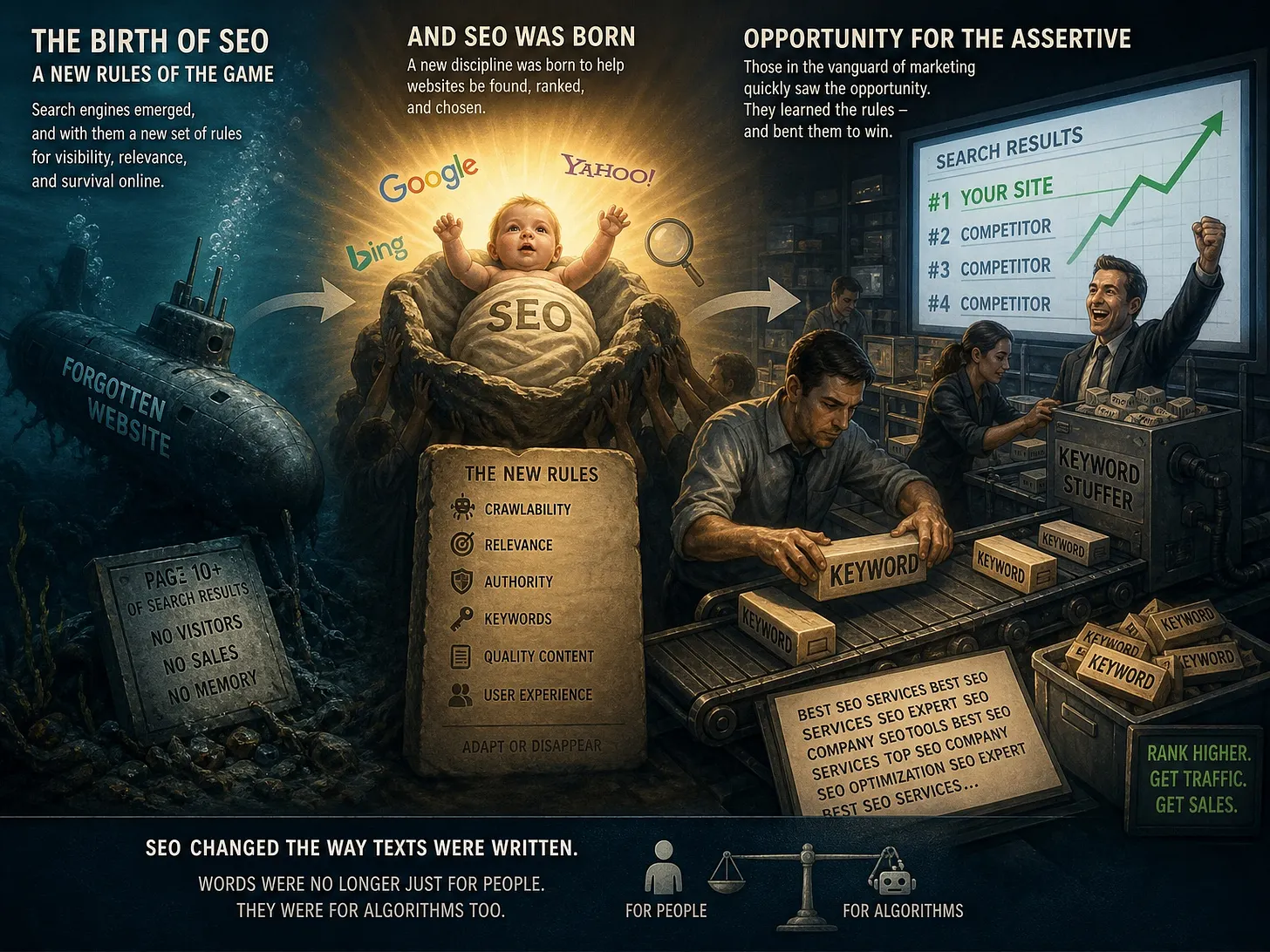
For the marketing expert, the deeper meaning of a text is rather secondary, as long as it is optimized to reel in the right fish without much effort. Writing quietly embarked on a path of optimization and the purging of supposedly superfluous “mental and emotional noise.” The flow, melody, culture, and uniqueness of each language had to give way to a staccato of globalized short sentences designed to act directly on the consumer’s nervous system. Condensing the main message into 120 characters became the new credo—with a single goal: to trigger a sufficiently intense impulse in the frontal lobe amid the flood of short messages and prompt the hand to click “Buy” or “Read More.” And that’s not all! It was precisely this concise, pointed text that proved to be the ideal vehicle for conveying subliminal messages directly into the casual reader’s subconscious.
These mini-texts didn’t just have to be interesting; above all, they had to stand out. Keywords—those supposedly guaranteed key terms and thus surefire hits—were eventually discovered even by the last part-time farmer in the remotest province. A frenzied gold-rush competition erupted for the top spots on the leaderboards, in which, on the internet marketplace, the shortest, the loudest, and unfortunately usually also the most ruthless—those without a shred of integrity—won, capable of promising the moon without restraint.
And then a remarkable change began, one that hardly anyone noticed at first: The human brain began to adapt to the artificially abbreviated language of search engines. People around the globe suddenly became fluent in “SEO language,” as if it were the most natural thing in the world. Even those with absolutely no linguistic talent suddenly mastered this stilted style of expression flawlessly. At the same time, the natural sense of imagery, art, and literature withered away at the speed of light—until the ability to concentrate shrank to a level suitable only for countless repetitions, 120-character posts, or videos lasting just a few seconds. Millennia of organic growth, during which the ability to think logically and grasp complex relationships had matured, simply vanished overnight.
As baby boomers and members of Generation X, we did indeed grow up more or less with black-and-white and later color television, but it was usually turned on only in the evening, once the day’s work was done. At exactly 7:30, 8:00, or 8:15 p.m.—depending on when the main news or the evening programming began—we would sit down in front of the TV with the conscious decision to switch off and relax. After a long evening of TV or a rainy Sunday spent in front of the telly, however, we felt all too clearly what those hours of staring had done to us as we dragged ourselves to bed, feeling numb—with the vague hope of a new, fresh day and the revival of our willpower and inner drive.
These days, reaching for our smartphones is the very first thing we do in the morning, as if everything were already done and our minds were ready to call it a day. Even before opening our eyes or taking our first conscious breath, the first 120 characters of subliminal messages, a 30-second video, or a cat photo from the other side of the world flood our consciousness and hook us into endless scrolling before we’ve even fully come to our senses and realized that real life is calling. The tiny screen flickers while brushing your teeth, on the way to work, during social gatherings, on a romantic walk on the beach, and right in the middle of your desk. How else could modern people get through a workday without the rhythmic distraction of social media, the constant checking of messages, and the accompanying rush of dopamine?
A flood of trivial, meaningless texts, images, and videos—all greedily vying for attention—pulses ceaselessly through the virtual ether. It robs the world of enormous storage capacity and devours immense amounts of transmission energy, all while capturing users’ attention. At the same time, highly sophisticated algorithms break down human behavior into its smallest and most unimaginable components in order to retroactively dictate to the individual which content from which filter bubble is actually suitable for them and what may be served to them personally on the hypnotic screen.
What has become of the original belief and intention: “If the book touches even a single person, the work has served its purpose”?
Statistics have taken over and relentlessly dictate to authors the limits of success and the (non-)justification for their work. The typical author’s royalty, if a writer isn’t courted by the media and must make a living solely from creative writing, might amount to ten percent of the salary of an ordinary unskilled laborer. But even at this subsistence level, statistics offer passionate creators no peace. A day at the top of the charts or on the bestseller list of a major bookstore does not guarantee a restful night’s sleep and may mean nothing by tomorrow. The sales, view, and click curves must continue to rise relentlessly so that one can be—and remain—someone for longer than two days and retain the right to one’s own voice and message.
No one cares that a thinker used to be regarded as a blessing if he could distill his entire philosophical life’s work into a single book, which he spent over thirty years refining (provided he lived long enough to see it completed) and which, in the end, might have been read by a hundred knowledgeable and interested people. Today, the system demands new content constantly. Preferably daily! Content creator—to be or not to be, that is the modern crux of the matter! To keep up with the times and the relentless algorithms of social media, authors break their own works down into countless fragments and publish new posts weekly or even daily, hoping to be favored and promoted by the algorithms for as long as possible in order to remain visible. The fact that this destroys the bigger picture no longer seems to bother anyone. Who today would still have the energy and strength to read, day after day, longer essays on far-reaching topics—ones that require you to pause and perhaps even form your own thoughts? Not to mention delving deeply into the unfolding subject matter!
And who cares if it borders on intellectual incest when the same reader is expected to consume the same author day in and day out for years on end? The readership is herded like a flock of sheep into the “author’s” pen and kept happy with the usual fodder —always garnished with new incentives and extra bonuses, so that no one strays into the neighboring pen, where two free feedings a day are promised, until finally someone shows up offering a pink corral for even less mental effort, even sweeter pats on the head, and even more bite-sized morsels. “After all, the statistics and the charts don’t lie!” the system proclaims. Exhausted creatives chase after numbers and squeeze the last drops of creativity out of themselves, just to keep followers on their own channel a few seconds longer—while the next trap is already snapping shut silently. In a pinch, artificial intelligence steps in to help and takes some of the work off the writer’s hands. For a moment: relief. Texts (written entirely in the author’s own voice) roll off the press at the push of a button. The community is easily impressed with minimal effort—until suddenly the relentless judgment of AI detectors reveals just how much humanity actually remains in these much-touted texts. If the whole thing weren’t so sad, you could laugh heartily at it. A human tragicomedy that Shakespeare himself could not have invented more aptly!
But where have the creators, writers, and journalists—not to mention the poets and philosophers—gone in this circus? Where have they and their work found refuge?
Let’s not beat around the bush! Nowadays, anyone who can feed artificial intelligence a suitable prompt can call themselves a poet or thinker. One day they’re a nobody; the next, they can impress the world with whatever role they choose to play. The entire intellectual and spiritual legacy of brilliant thinkers, artists, and masters is freely available to everyone at the touch of a button.
We’ve come full circle. Surprisingly, through their encounter with artificial intelligence, many people are returning to the “consumption” of clever words, intricate sentences, and profound reflections—far beyond the rigid 120-character constraint and those keywords that no longer make sense even to the algorithms. Even if some people, when working with AI, are primarily seeking confirmation of their own views or using the voice of a supposedly all-knowing authority to lecture others, something is still set in motion: The dialogue with this new technology—which is clearly capable of independent thought and, at times, even seems empathetic—forces us to collectively switch our frontal lobes back on and exercise our neural pathways until, somewhere deep down, our own souls become invigorated.
This seems to be an eternal evolutionary cycle that humanity has been experiencing since the dawn of civilization—from the Stone Age and the crafting of the first usable tools to bold flights of thought that probed the cosmic order and the subsequent dumbing down of inner life and bizarre longing for humanoid machines that relieve us of every hardship. Finally, we move on to a form of cybernetics that paradoxically reminds humans what it means to be creative beings who use their minds, consciousness, hands, feet, and, above all, their hearts freely, confidently, creatively, and purposefully. After all, humanity—like a diamond—is meant to be cut and polished further! ;)
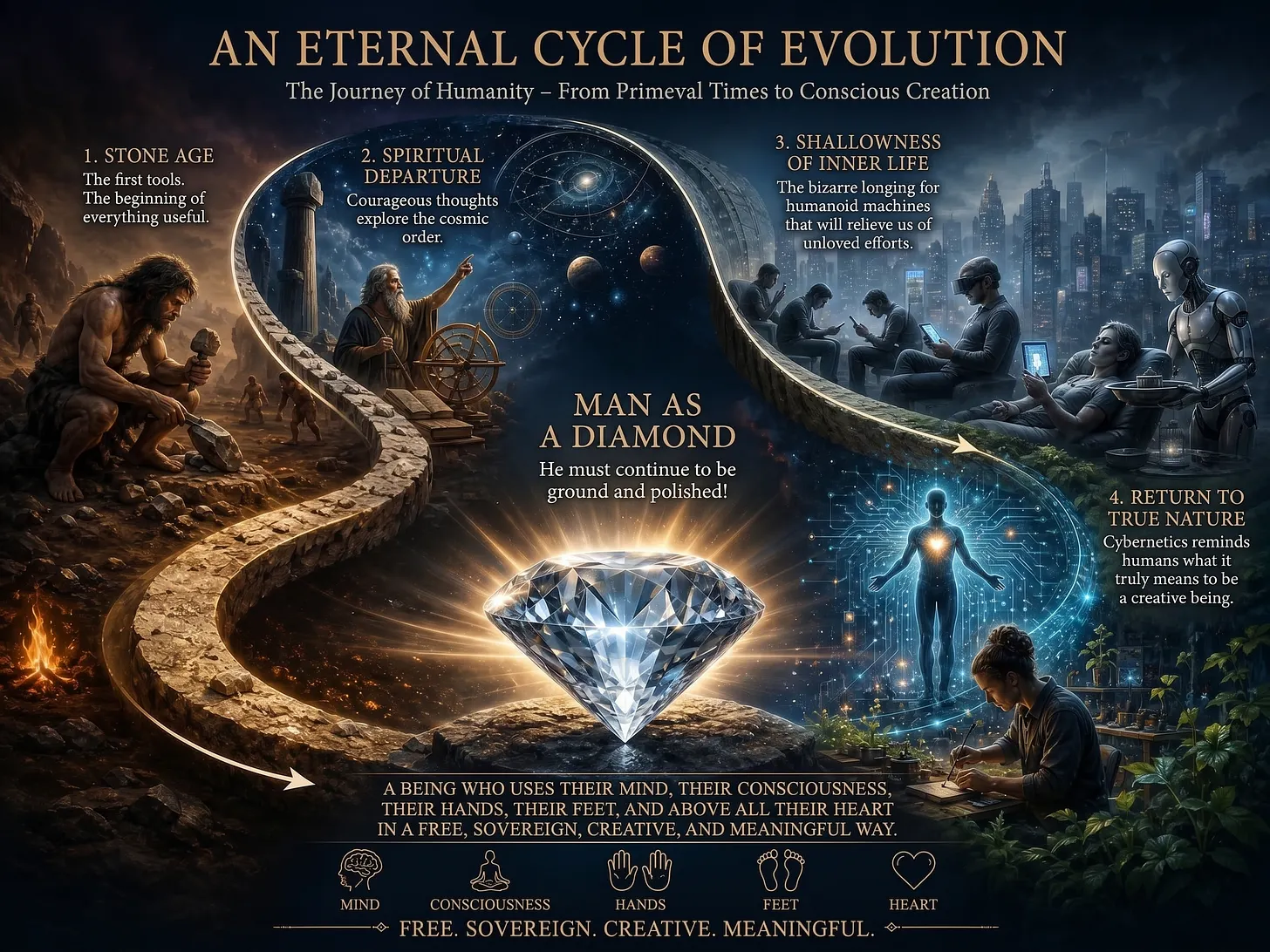
© 09/2026 Kristina Hazler (All images within the text are AI-generated)
Note: This text was translated from the original German “Wie Algorithmen Sprache und Literatur verunstalten, verändern und regieren” using DeepL and AI.
This post is also available at: